MY ANSWER to the 1st part: By not following social media influencers, or take their rants seriously ... by reading the original scholars like ( Carl Jung, James Hillman, Marion Woodman, Richard Schwartz, Peter Levine, Bessel Kolk, Stephen Porges, Bruce D. Perry etc. ) and evaluating and comparing each and every line you read with your personal insights gained through intuitive self-exploration of your internal experience! put any thing you read on hold if it doesn't match with your intuitive self-reflection ... your or other's over reactions, triggers and fears can also give indepth insight ...
Discard any experts or school in psychology who explicitly reject the existence of human soul or is grounded in purely materialist world view ...
And do not go near Freud, at least in the beginning, and even if you read him, do that from purely from an academic perspective ...
I have found Jungian psychology to go toward depths which other schools of thought in psychology are not even aware of ... but of course one should keep wearing their critical lenses while reading any school of psychology ...
Up till now I have found the work of Jungians (Jung himself, Hillman, Woodman, Franz etc) and the work of Trauma psychology (see Peter Levine, Bessel Kolk, Gabor Mate', Stephen Porges) and the original work of Bruce D. Perry in Neuro-sequential Development, and the work in the domain of Islamic psychology like that of Abdullah Rothman to be overlapping and converging toward some common points, which also aligns with my own intuitive reflections on the subject ...
Now, Why learn it?
Don't we deal with humans all around in all shapes in sizes, in family, at work place, on the road, etc. if we have a better understanding of how their hearts, minds, souls, brains, guts, bodies are all working together, then we can save ourselves and others from a lot of trouble which we otherwise unintendedly get into ... and I can bet that our understanding a.t.m about who we are, how we function and how others function is profoundly limited and is already causing lot of troubles perhaps everywhere for almost every person around ... leave others aside for a moment, self-awareness - I have come to believe - is critically important for our personal well-being, and also to strengthen our connections with our Creator ...
> Knowing the source of your fears, anger, frustration, urges, cravings, sadness, grief etc ...
> Knowing the story behind your wounds, how deep the wounds are, how much they hurt or had hurt ...
> Know the content of your shadow, and the nature of demons which lurk there
> Knowing your longings, calling, purpose, the meaning of your life which emerges from your core, and how you align it with your belief system
> Knowing your limitations and for what exactly you will need help from others and your Creator
> Knowing your needs and wants and the difference between them
> Knowing the values or principles you stand for and the ones you feel less concerned about, when and why ... (Often people compromise on their principles in front of some people)
> Knowing why you like or dislike something, not just rational but emotional reasons also ...
> Knowing your core / primary intentions behind every action/decision or preference
> knowing reasons (emotional in particular) behind your priorities
> Knowing your biases, perceptions and to what extent they distort the view of reality, and the sources of your biases ...
It's not a short journey of course, but I believe one need to be on it if they intend to come in terms with their own self ...
Either you bump your head somewhere, or someone scratch your car, or you see garbage on the road, or your favourite sports team lose a match, or a dear one leaves this world, or your property is demolished on accusation of illegal encroachment and there is no one to give you justice, etc. etc., unpleasant events push us into grief, minor or major, but some level of grief is generated ... if so then there are five levels of grief: 1) Denial, 2) Anger, 3) Sadness, 4) Sense making, 5) Acceptance ... in case of major grief, we even move back and forth on these stages many times over the period of months if not years, and may pass them within a few minutes if the incident is small ...
The common mistake here, which is almost become a cultural phenomenon, is to jump on to the sense making stage without completing the anger and sadness stage. This i believe could be because of western antagonism against eros (our emotional side) and glorification of logos (our rational side) ... whatever the reason maybe, we end up accumulating grief in our system, which makes us reactive in the long run, and then we stress out ourselves while suppressing the accumulated grief as no one wants to see our ugly outbursts. But this suppression just make it worse eventually.
People then instead of looking at the root cause keep using some distraction strategies to keep calm or motivated, even use medicines to numb themselves ... Sense making is a necessary part of the process but can be best used when we fully allow ourselves to pass through the 2nd and 3rd stages ... so as Stephan Covey says 'first thing first' ... Sad part is, our modern lifestyle doesn't give us enough space for this purpose, so creating such a space need to be a necessary life goal and a mandatory act of self-care we need not ignore ...
Experiences if too painful are pushed in to the unconscious naturally, but only to be purged out later in life to unload it's burden but it's not easy.
So, the unconscious or the shadow purge stuff out into the consciousness only when its possible for the person to bear the difficulty of the subjective experience.
Our unconscious even influence our choices to make us go through the same experiences, and it keep making us do that until we are fully conscious of the subjective aspect of the past experiences, or fully feel the emotional content of the experience with conscious awareness ...
Once the subjective content is fully purged out into our conscious awareness, our unconscious no more push to make us repeat the experience, at least on a subjective level ... we move on and no more remain stuck in the past ...
The ego though always try to counter the tendency of the unconscious to keep the subjective material in the shadow, but conscious-will can be used to ask the ego to step aside so that purging happens uninterrupted ...
If it's too much to handle in one go then purging out will happen in stages ...
(Inferred after reflecting on the work of Carl Jung, Marion Woodman, Peter Levine, Bessel ven der Kolk, Richard Schwartz, Gabor Maté etc.)
Stress can be because of a few reasons. External stressors in the environment like a toxic work culture, unemployment, poverty, toxic or abusive relationship with family members or partner, etc. can cause a lot of stress. Or it could be because the nervous system has been stuck into a disbalanced state with a sympathetic dominance or the part of the autonomic nervous system (the sympathetic side) which is responsible for generating a stress response is not able to let go. If a stressor in the external environment has stayed for too long, like for few months or more, it’s possible for us to get stuck into a stressful state, and remain there unless a deliberate attempt to release the stress is not made. We can even stuck into such a state because of a high stress event like an accident or surgery even. Another important reason can be the inability to be to true to your emotions like anger and frustration and not being able to express them openly because of fear of rejection from people you depend on for financial or emotional support. Again remaining stuck with such people for long can put you into a habit of pushing your difficult emotions under the carpet and not allowing yourself to feel them fully, or express them even in an appropriate way even if the same people are no more around.
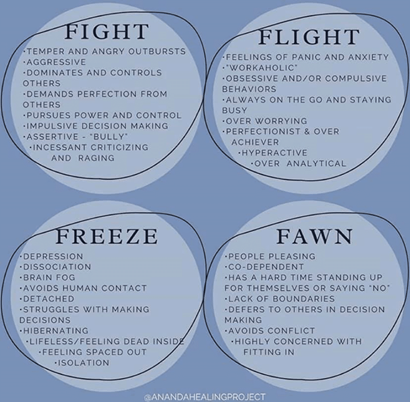
According to Peter Levine[1] and Bessel Ven Der Kolk[2], external stressors either long term like an abusive relationships or short term like a car accident, create a fight or flight response in our bodies. The body accumulates high amount of energy to generate a fight or flight response, and if we perceive that it is not possible to do that, then our nervous system typically shut us down and force us into a freeze state. In case of an abusive relationship or an unavoidable toxic work culture a response may even be to passively comply with all the demands to prevent any backlash, this can be referred to as ‘fawning’ (see Figure 1 above).
We are under stress when the energy mobilized by our nervous system to fuel fight or flight response is not fully allowed to do its thing. The energy which is stuck in our system is also referred to as trauma by Peter Levine, the more it is and the longer it remains stuck, the worse its impact on the systems in our body, immune system in particular. Often we suppress the fight or flight response because it may appear to us as socially inappropriate. Staying in such a situation for too long can make our nervous system stuck into a stressful state where the sympathetic part of our nervous system remains dominant, while the parasympathetic part become less or no more active.
Following is a list of activities recommended by different experts to regulate one’s stress:
24. Spending time with children (for the elderly) (JM)
So if the stressor is external, and it remains there, then doing the activities mentioned in the list of stress regulating activities above may have a limited impact, as the external stressor will keep triggering the sympathetic side of the nervous system. This implies that getting out of the external stressors is fundamentally necessary. This is very unfortunate for people who are stuck in poverty, unemployment and toxic relationships where escaping the circumstances is beyond their control[3]. Lockdown ironically has worsen this situation for many[4].
But somehow if you are lucky enough to have eliminated the external stressors or got rid of them or at least have been successful in creating some space for yourself despite the presence of external stressors, and wants to complete your stress cycle, then you can start with different activities recommended above.
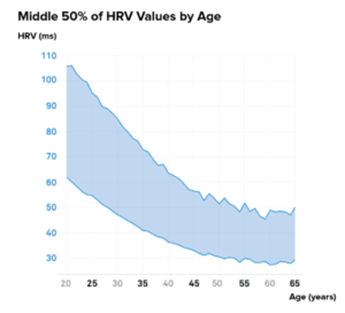
Your choice of activity may depend on how much stress you have stored in your body. HRV is now being recognized as a sound measure of autonomic disbalance. If you have a smart watch or a wristband, then you can simply measure your HRV value over the period of a few weeks, and see if it’s on the lower side, if so then it perhaps means that your sympathetic part of your nervous system is more active than it should be. In parallel also notice:
· If your sleep is constantly disturbed
· If you are addicted to something (including work, shopping, music, games, junk food etc. and avoiding them generates withdrawal affects)
· If you panic easily or If some trigger gives you a full blown panic attack,
· If you feel sacred or anxious for no apparent reason
· If you get angry easily
· If you breathing is shallow,
· If you remain alert most of the time,
· If you easily get irritated most of the time,
· If you crave to eat junk or processed food more,
· If you get tired or burnout easily,
· If you get allergies or catch cold easily, or suffer from irritable bowel syndrome, or autoimmune,
· If you find yourself demotivated or have lost interest in what you loved to do
· If you find it hard to focus on the content of the present moment
· If there is constant tension in your muscles like in your shoulders or neck
(There are some stress measurement scales developed by concerned experts, click here to jump to them)
If some the above happens then perhaps you have stress stored in your system, and more of the above means more stress. So depending upon how much stress there is and how much it is stored there and for how long and for what kind of circumstances, you might want to pick up the activities mentioned in in the list of stress regulating activities above.
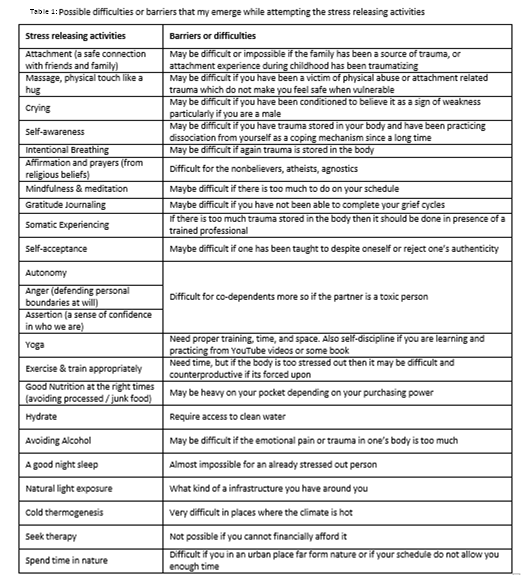
But the choice of activities is not as straight forward, and depends on some factors. If you are already stressed out then it might not be possible for you to sleep regularly and deeply unless you get it out of your system, if you are addicted to something, then again you would have to work on releasing some of the stress otherwise the withdrawal affects may be devastating. I personally find working-out difficult if I am stressed out. If you have been conditioned to believe that crying is a sign of weakness particularly if you are a male then you might find it hard to cry even when you need to. Lack of belief in yourself may not allow you to assert yourself, be autonomous, more so if you are co-dependent on your partner. If you have not been able to complete your grief cycle then it may be difficult to develop a sense of gratitude for what you have.
Table 1 below can help you evaluate which strategy to pick first depending on your circumstances and experiences. You might notice that trauma and stress trapped in one’s body in itself is a barrier in doing some of the above activities. But if one is able to bring the stress levels down by starting the activities which are easier (like getting some sunlight, trying some somatic awareness and experiencing, keeping hydrated, talking to some friend, writing down your feelings, or intentional breathing etc.) and release or process some of unresolved trauma then eventually they can get easier and may further help in keeping the stress and autonomic balance in control.
Chronic stress is painful, it literally cause inflammation in the body, which in turn may also cause depression as well. The resulting personality and behavior may not be socially acceptable or may put one’s financial security at risk. So if that is true for you then you might be unconsciously seeing yourself negatively as well. Gabor Mate says that often during childhood, children learn to prefer attachment over authenticity, they perform as per the wishes of their parents while suppressing their authentic reactions to unpleasant situations. So as a child you might have learnt to suppress your anger or disgust because it agitated your care givers [5].
Looking closely, it appears that the problem of stress is primarily a problem of disconnecting with one’s self, losing touch with one’s physiological and emotional needs as they arrive, for the sake of forcing ourselves into performing as per socially acceptable standards or as per the wish of a people around, more so if we are dependent on their acceptance or financial security. You cannot yell at your boss despite how toxic he or she maybe or leave the job just like that because of the obvious repercussions.
When we spend too much time in circumstances where we have to ignore our need to fight or flight or freeze for months or years, then a point come that we even forget what the need actually were. We just automatically drag ourselves into an unhealthy repeating pattern of suppression and performing in socially acceptable way, which turns vicious with its consequences on our psychological and physiological health. Constantly focusing on the things to-do at home or at work, perhaps makes us even oblivious of our needs to even breathe deeply, keep hydrated, go to toilet on time, take some sunlight, or consume healthy food, etc.
So the journey of recovering ourselves may start from noticing at first what actually our primary needs are!
Try to bring more and more focus towards your body to relearn what it actually needs, and try to honor the needs as they arrive. But if you have been disconnected for a long time then you might not even recognize at first what the need actually is, and it might even freak you out or even give you a panic attack. So try to go as slow as possible. Imagine if you have been ignoring even pushing away a person you live with for a long time, and then try to reestablish the relationship when you do not even know the language the person speaks. It is definitely tough at first.
You can start by paying attention to the minor needs emerging in your body like the need to change the posture while sitting, taking a deep breath every few minutes, drinking water as soon as the need arrive, etc. The needs appear minor but acknowledging them serves an important purpose: when we begin to notice and honor the needs, we eventually begin to form a long broken relationship with ourselves. Self-awareness can lead to self-understanding, and then deliberate attempts to honor the identified needs can eventually lead to self-acceptance and self-respect.
Peter Levine suggests that our bodies knows it naturally how to release the trapped energy, like it will shiver, tremble, tears will come out, breathing will become intense, you will fidget more, you might feel an instinctive need to move or shrink or stiffen certain muscles. Important thing is to form this relationship of respect where we listen to the body’s urges and create a safe space to behave the way it wants to behave [6].
It should be noted that stuff which people are addicted to like smoking, alcohol, sugary stuff, junk food, pornography etc. are not the needs, rather they are stuff which people consume to distract themselves from the pain of their unmet needs. If the primary needs are met instead, the addictive tendency may decline. Relapses will happen, but their frequency will slowly reduce. It may take a few months to a couple of years depending on the disconnect to form a relationship with oneself where we understand, value and honor all our needs, and thus eliminate the need to suppress the pain through smoking, alcohol etc.
The self-awareness will also help eventually to pick an activity from the list and not feel bad if the body resist instead, because there always is a good reason. Like if your body is resisting working out then there may be inflammation in your body, and working out may make it worse when your immune system rather pushes you to rest instead. So the self-awareness and respect will slowly tap in the wisdom of your body, and will eventually help you pick the next activity to incorporate in your lifestyle.
Most of the activities mentioned in the list above will not require some extra time, except like yoga, spending time in nature, and working out, but are to be integrated in our way of life, and state of being. So Pick up the stuff from the list, and see which are difficult for you and which are manageable, which can be immediately incorporated and for which you will eventually need assistance like therapy. You can then start with the stuff which you find easy.
Recommending readings
· ‘When the Body Says No’ by Gabor Mate (on the impact of stress on our bodies)
· ‘Why Zebras Don’t Get Ulcers’ by Robert Sapolsky (on the impact of stress on our bodies)
· ‘Cure: A Journey into the Science of Mind over Body’ by Jo Marchant (how our mental state affect our health and possible ways to cure)
· ‘The Four Pillar Plan’ by Rangan Chatterjee (on lifestyle changes to boost immune system)
· ‘Immunity: The Science of Staying Well’ by Jenna Macciochi (on lifestyle changes to boost and protect the immune system)
· ‘Burnout: The Secret to Unlocking the Stress Cycle’ by Amelia Nagoski and Emily Nagoski (on how to release the stress trapped in your body, but may not work for people with severe trauma)
· ‘Walking the Tiger: Healing Trauma’ by Peter Levine (on somatically releasing trauma from our bodies)
· ‘When the Body Keeps the Score: Brain, Mind, and Body in the Healing of Trauma’ by Bessel Kolk (on how the trauma is stored in our bodies and different therapeutic techniques to release it)
[1] Levine, Peter A. (2005). Healing trauma: a pioneering program for restoring the wisdom of your body. Boulder, CO: Sounds True
[2] van der Kolk, B. A. (2014). The body keeps the score: Brain, mind, and body in the healing of trauma. Viking.
[3] Maté, G. (2003). When the body says no: The cost of hidden stress. Toronto: A.A. Knopf Canada.
[4] Jia, R., Ayling, K., Chalder, T., Massey, A., Broadbent, E., Morling, J. R., Coupland, C., & Vedhara, K. (2020). Young people, mental health and COVID-19 infection: the canaries we put in the coal mine. Public health, 189, 158–161. https://doi.org/10.1016/j.puhe.2020.10.018
Bourdillon N, Yazdani S, Schmitt L, Millet GP (2020) Effects of COVID-19 lockdown on heart rate variability. PLoS ONE 15(11): e0242303. https://doi.org/10.1371/journal.pone.0242303
Généreux, M. et al. (2021). The evolution in anxiety and depression with the progression of the pandemic in adult populations from eight countries and four continents. International Journal of Environmental Research and Public Health, 18(9), [4845]. https://doi.org/10.3390/ijerph18094845
Our nervous system is designed to complete it's emotional reactions to adverse external situations. If somehow we are unable to complete that response in real time, our nervous system will find every opportunity later to complete it.
Any reminder to the original event in the past will trigger the residual response.
We try to suppress it again typically because often it is not making any sense, but if we understand that it is not the present event to which our nervous system is reacting, but to some resembling past event, then we may allow and create space for the emotional reaction to complete (with due diligence of course).
But if we keep accumulating then the over load on our system can create some serious damage in the long run ...
Often intellectual or spiritual bypassing is used for that purpose!
Bypassing, is the use of some intellectual gymnastics to distract one self into an illusion of wellness.
This often involves creating rational justification of the discomfort being felt in our hearts and bodies as a result of some difficult experience.
We then focus on this rationalization so much that we tend to forget what's actually happening within ourselves. This can create a false sense of wellbeing.
Spiritual bypassing involves rationalization of some beliefs to force ourselves into this false perception of wellness.
Bypassing thus evades the natural and Divine process of restoration and healing, which is activated by embracing and by not evading the difficulty of the experience.
The pain is also not a sign to run away from our internal experiences, its a signal by our defense mechanism asking the higher self to let the healing system to do it's thing.
If you are feeling pain it's because your system is healing your wounds. But bypassing makes people feel numb, and they perhaps fall into this illusion of wellness ...
Being spiritual or having a deep connection with the Divine is not suppose to make you emotionally numb or sterile ... it rather creates an internal safe space to experience all the difficult emotions, a space where difficult emotions turns into a catalyst to strengthen the Divine connection, a space where these emotions transmogrify into hope, calmness, peace while also bringing a sense of gratitude ...
In fact, it has also been observed that often difficult emotions force us into a spot where we don't have any choice left but to find this space inside of us, where we are completely vulnerable and left with no other option except to seek help from the Divine ... and eventually we experience the healing through the Divine light which thus brings a sense of bliss and serenity ...
But we can't find this space or connect with the Divine if we keep forcing ourselves into a delusion of wellness during moments of pain while pretending to be religious and spiritual, which also prevent us to experience the sweetness of the healing process ...
Intellectual or spiritual bypassing thus prevents us from connecting to our core and thus disconnects from the Divine as well ...
There is a two layer filter between you and any other person around, even the ones who are closest to you.
One layer is their own perception of who you are, and likewise there is a perception you have of who they are ...
We typically react to what the person in front brings out from with in us, and this happens both ways ...
So, when two people interact, they often interact not to each other, but to their own inner experience which is more dependent on their past experiences and less to what the other person is doing or saying ...
So, if both can't see their own perceptions, and mistake it as objective reality, then both gets trapped to their own inner experiences of the person in front.
Its like echoing inside an invisible shell, and not really interacting with others around ...
This happens more with people who are unable to process the subjectivity of the present experiences if its difficult, which accumulates at the back of their mind and eventually distorts their experience of the outside world ...
That's probably the case with 99.999% around us ...
In other words, people live in a matrix of their own unresolved, unprocessed subjective experiences which if left unresolved and unprocessed furthers the distance they have between themselves and reality ...
So typically they don't see you, but themselves, and you don't see them, but yourself ...
Waking up and coming out of this matrix can be a very lonely experience ...
I asked students in a class if they would spend a week alone without any cellphone etc, just themselves, nothing else, in a room (except food which they would also consume alone and bathroom breaks).
Almost everyone said it would be almost impossible. Some even said that they might even kill themselves if they are forced to do that.
This perhaps implies how much at war the youth maybe with themselves, so much that they are even haunted by their own existence, as if their existence is an unavoidable discomfort from which they need to keep themselves distracted.
They have been perhaps taught to despise and reject parts of themselves, push them into their shadow, so much that they don't even know what they are, even scared of those parts.
Any necessary personal change or personal accountability also become difficult with such disconnect, because of the counter resistance from the rejected parts. These rejected parts even get into conflict with others to vent out their frustrations caused by perpetual rejection.
Self-awareness, self-understanding, self-acceptance, self-compassion is therefore fundamental here for not just being at peace with one self, but to grow and fruitfully hold one-self accountable when needed ...
What does it mean to be emotionally/mentally healthy? A checklist based on my readings and exploration of the subject:
>Being consciously aware of the contents of the present moment including somatic awareness without a persistent urge to zone out
>To #mindfully feel the entire range of positive and negative emotions without the urge to repress them, or being self critical of any of them
>Capacity to notice and identify each emotion (emotional literacy)
>Ability to act on will on the demands of each emotions or emotional + somatic needs
>Knowing the limits of conscious controls (ego) and surrendering to autonomous systems of one's being
>Ability to hide if necessary yet feel the full force of emotions without suppressing them
>Ability to say no when needed, defending personal boundaries without guilt or shame
>Being able to simultaneously feel conflicting emotions like grief and gratitude, fear and joy, anger and compassion
>Ability to experience gratitude at will without suppressing grief if any ...
>Letting oneself to complete the grief and stress cycles when needed, finding space to do so at will
>Self acceptance, self compassion and ability to forgive oneself when needed, not being over confident let alone narcissistic,
>Feel guilt without shame after a mistake, or ability to accept mistake and correct oneself
>Easily able to defend oneself when falsely accused
>No urge to show-off for social acceptance or seeking approvals
>Being aware and at peace with the contents of the shadow self
>Being aware of the core intentions
>Ability to listen and trust ones intuition
>Ability to form meaningful and healthy connections
>Being vulnerable and seeking any help when needed, knowing the apt company for this purpose
>Ability to identify potential abusers, manipulators, exploiters and avoid them
>Ability to see the unconscious projections, biases, prejudices, stereotypes which may distort, exaggerate or undermine the seriousness of a threat
>Being at peace with uncertainty, doubt, unanswered questions, without the urge to suppress any resulting stress or fear
>Being at peace with one self, while mindfully being aware of any internal conflicts
>Doing the right thing or avoiding the wrong not for social acceptability rather to honor ones conscience or uphold a moral principle
>Ability to be empathetic and be compassionate to those who need it
The list is not exhaustive, additions are welcome in the comments below!
In a I think it's all about the balance between the need to be authentic to one's self and the need to connect to others ...
Compromising ones authenticity for connection can lead to various psychological illness: depression, hypertension, stress and anxiety being the common ones ...
Conversely, manipulating others to submit to your authenticity, even using exploitation and abuse can turn you narcissistic or into a sociopath, which is also seriously problematic ...
We have a culture of ignoring psychological needs, more so in the modern world ...
They are ignored so much that one even forget there are needs like completing the grief and stress cycles, being in a safe company when vulnerable etc.
Our nervous system gets overloaded and reacts (fight/flight/freeze) ... we then gaslight ourselves on being reactive because that's how we have been treated by others as well against such needs ...
We are gaslighted because reactions are also not socially acceptable (لوگ کیا کہیں گے) ۔۔
We are rather expected to practice alternative socially acceptable behaviors, but never address the root cause of our reactions.
We are expected to force ourselves into certain social norms, and even religious card is used for that matter even, despite religion originally has nothing against those ignored primal psychological needs, rather help in fulfilling those needs in many ways ...
Typically many of us distract or dissociate ourselves into a mental idea of gratitude to avoid the experience of pain to look tough or pretend to be alright or whatever...
So instead, we need to view pain as an alarm system, like if you have a dog which disturbs your sleep by barking out loud to alert you in case some thief try to enter your house, you don't try to silence the dog rather appraise the dog for alerting you and take the action against the thief ... Same is the function of the pain in the body, it alerts us to take corrective action, its an alarm system which need not be shut down, it's a signal for us to respond to the disturbance in our system. The pain thus serves an important purpose, for which we need to be thankful ...
There are no false alarms in our body, we just fail to understand the source of the pain, particularly emotional pain ...
Secondly, pain makes us ask for help, particularly from Allah s.w.t. We need to know the limits of our ability, for example, how much activity on a cellular level we can control in the healing process of a cut in our hand. Allah s.w.t designed this system of healing, and we need to give up to the system during the moments of pain, and be thankful for its autonomous activity to restore order in our bodies.
The moment we realize the extent to which we can control the system to recover from the injury, its the moment when we move into the state of vulnerability. In this moment of vulnerability we can cry for help from Allah s.w.t., and be thankful for the opportunity for that purpose ...
The sooner we notice pain and surrender to the process (after taking any action which we possibly can) the sooner the Divine system of healing can be activated ... while we wait for the Divine system to do its thing we can be thankful for the past experiences of healing, and be thankful for the outcome of healing in advance ...