Showing posts with label Alternate Education. Show all posts

Tuesday, February 3, 2015

Pedagogy for Entrepreneurship

By Omar Javaid

The idea of entrepreneurship being a viable, lucrative and possible career option is being promoted all across the country keeping in view the economic challenges such as unemployment; the untapped opportunities & potential we have.

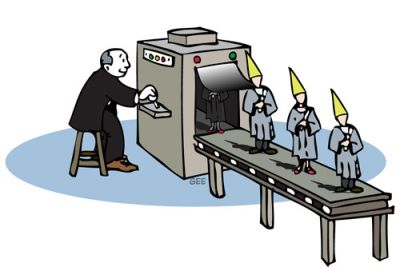
The system of education which the country has been following up till now was developed & perfected to meet the requirements of a very different kind of circumstances. 2013 TED prize winner and renowned educationist Sugata Mitra explains it as a perfect system to produce managers for a Weberian style bureaucratic machinery which in fact still exists, but perhaps not for so long. The graduating students were/are considered as standardized 'products' as if they were coming out of an assembly line. Renowned educationist and thinkers like Sir Ken Robinson, Noam Chomsky, Seth Godin, and futurist Alvin Tofler has compared the traditional design of education system with the design of a factory intended to transform students into subservient beings who submits themselves to the rules of the organization and authority, who are void of any critical thinking, have identical dialects, who largely thinks and stays within the box and are afraid of experimentation and making mistakes or take risks.

Friday, December 26, 2014

Our Higher Education System is Broken - Do You Agree (Last Part)

Click here for part 1
Click here for part 2

The incompatibility of current higher education system with the realities of the 21st century is obvious. If you represent the 19th century with the shape of a square, the 20th century with oval, and the 21st century with circle, and then try to fit the circle inside an oval inside a square, you would understand the problem statement better.

We need to ask: is knowledge transference as educational goal, lectures as instruction strategy, textbooks as instruction resource, rote learning to pass examinations, and grading as motivation for learning irreplaceable truths of education?

Or are these components of a higher education system necessary evils?

The problem is that instead of rethinking knowledge transference as the be-all and end-all of all educational activities, we are simply denying and rejecting it as our current educational goal to begin with. This is nothing but self-deceit. Otherwise, what outcome does one expect from a lecture and textbook based instruction and where students are implicitly encouraged to rote-learn and study for sake of grades?

Friday, December 19, 2014

Our Higher Education System is Broken - Do You Agree? (Part 2)

Click here for Part 1

By Farhan Noor

In previous post, I spoke about how the 21st century higher education system is almost the same system as the 18th century higher education system, going back as far as the 11th century in history, and even earlier, in some aspects.

In this post, I will go into the details and explain how that is so

***

To illustrate, consider the following 5 mutually reinforcing, interlocking components of the current Higher Education System developed centuries ago and which still exists today: i) Knowledge Transmission as Educational Goal; ii) Lecture as Instruction Strategy; iii) Textbooks as Instruction Resource; iv) Rote Learning to Pass Examinations; and v) Grades as Motivation for Learning.

Friday, December 12, 2014

Our Higher Education System is Broken - Do You Agree (Part 1)

By Farhan Noor

The purpose of this white paper is to fully convince the reader that our current Higher Education System is broken and therefore doesn’t work, especially not in this 21st century.

If, after reading this white paper, you remain unconvinced then I would have failed in my task.

I have presented overwhelming evidence—both logical and scientific in nature—to make what I see as a compelling case.

And have concluded with a request to government policymakers, university administrators, instructors, and students to convince others of the same. After all, the first step towards improvement is deep understanding and sincere acknowledgement of the problem statement itself; the solution comes later.

Tuesday, January 31, 2012

Schools: Factories to produce Mindless Individuals

by Omar Javaid, written for Homeworks Magazine (July Issue)

In view of Alvin Toffler and Sir Ken Robinson, the modern form of schooling was an offshoot of industrial revolution as it evolved around the human resource needs which emerged with emerging factories. Batches, fixed sessions, bells, unchallengeable supervision, uniforms, competition, number based evaluation, mindless-fragmented and compartmentalized activities, cut throat competition, disgrace to the failing ones, etc were all part of the school environment intended to produce a working class (or Human capital in view of Adam Smith) suitable for a very similar kind of environment prevalent in factories.

Tuesday, June 14, 2011

Is Future even Gloomier for Pakistan?

Sometime back I conducted a survey to check the aspiration of Pakistani Educated Youth, although the number of respondents were around 110, however the results were consistent with my own experience with students. Since last four semesters I have been asking all my students (around 1500 in total so far) the same questions and getting the same response. This time I only attempted to conduct the exercise through an online survey form. 

(Click on the images to enlarge)
Vision of the next 20 years

Tuesday, February 22, 2011

Education today is producing ... "Virtual herd of mindless consumers"

These horrifying lines are taken from the book "Weapons of Mass Instruction" by John Taylor Gatto, published by New Society Publishers, Canada in 2009. In the Prologue of the book, Gatto states: 
It was from James Bryant Conant - president of Harvard for twenty years, WWI poison-gas specialist, WWII executive of the atomic bomb project, high commissioner of the American zone in Germany after WWII, and truly one of the most influential figures of the twentieth century - that I first got wind of the real purposes of American schooling. Without Conant, we would probably not have the same style and degree of standardized testing that we enjoy today, nor would we be blessed with gargantuan high schools that warehouse 2,000 to 4,000 students at a time, like the famous Columbine High School in Littleton, Colorado. Shortly after I retired from teaching I picked up Conant's 1959 book-length essay, The Child, the Parent and the State, and was more than a little intrigued to see him mention in passing that the modern schools we attend were the result of a "revolution" engineered between 1905 and 1930. A revolution? He declines to elaborate, but he does direct the curious and the uninformed to Alexander Inglis's 1918 book, Principles of Secondary Education, in which "one saw this revolution through the eyes of a revolutionary:' Inglis, for whom an honor lecture in education at Harvard is named, makes it perfectly clear that compulsory schooling on this continent was intended to be just what it had been for Prussia in the 1820S: a fifth column into the burgeoning democratic movement that threatened to give the peasants and the proletarians a voice at the bargaining table. Modern, industrialized, compulsory schooling was to make a sort of surgical intervention into the prospective unity of these underclasses. Divide children by subject, by age-grading, by constant rankings on tests, and by many other more subtle means, and it was unlikely that the ignorant mass of mankind, separated in childhood, would ever re-integrate into a dangerous whole. Inglis breaks down the purpose - the actual purpose - of modern schooling into six basic functions, anyone of which is enough to curl the hair of those innocent enough to believe the three traditional goals of education listed earlier:
I. The adjustive or adaptive function. Schools are to establish fixed habits of reaction to authority. This, of course, precludes critical judgment completely. It also pretty much destroys the idea that useful or interesting material should be taught, because you can't test for reflexive obedience until you know whether you can make kids learn, and do, foolish and boring things.
2. The integrating function. This might well be called "the conformity function;' because its intention is to make children as alike as possible. People who conform are predictable, and this is of great use to those who wish to harness and manipulate a large labor force.
3. The diagnostic and directive function. School is meant to determine each student's proper social role. This is done by logging evidence mathematically and anecdotally on cumulative records. As in "your permanent record:' Yes, you do have one.
4. The differentiating function. Once their social role has been "diagnosed;' children are to be sorted by role and trained only so far as their destination in the social machine merits – and not one step further. So much for making kids their personal best.
5. The selective function. This refers not to human choice at all but to Darwin's theory of natural selection as applied to what he called "the favored races:' In short, the idea is to help things along by consciously attempting to improve the breeding stock. Schools are meant to tag the unfit – with poor grades, remedial placement, and other punishments - clearly enough that their peers will accept them as inferior and effectively bar them from the reproductive sweepstakes. That's what all those little humiliations from first grade onward were intended to do: wash the dirt down the drain.
6. The propaedeutic function. The societal system implied by these rules will require an elite group of caretakers. To that end, a small fraction of the kids will quietly be taught how to manage this continuing project, how to watch over and control a population deliberately dumbed down and declawed in order that government might proceed unchallenged and corporations might never want for obedient labor.
That, unfortunately, is the purpose of mandatory public education in this country. And lest you consider Inglis an isolated crank with a rather too cynical take on the educational enterprise, you should know he was hardly alone in championing these ideas. Conant himself, building on the ideas of Horace Mann and others, campaigned tirelessly for an American school system designed along the same lines. Men like George Peabody, who funded the cause of mandatory schooling throughout the South, surely understood that the Prussian system was useful in creating not only a harmless electorate and a servile labor force but also a virtual herd of mindless consumers. In time. a great number of industrial titans came to recognize the enormous profits to be had by cultivating and tendingjust such a herd via public education, among them Andrew Carnegie and John D. Rockefeller.